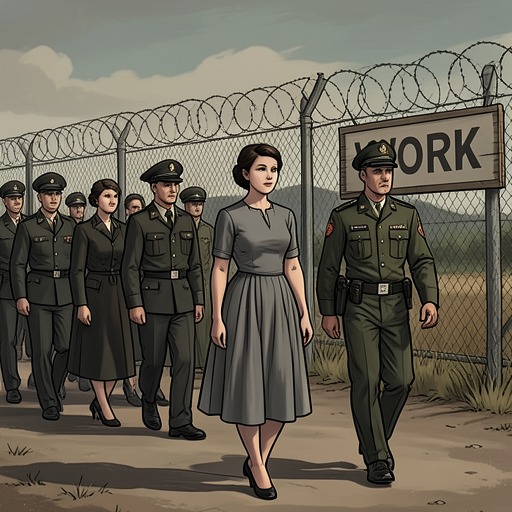
Bayer’s fatal drug experiments on female prisoners
The Zone of InterestBayer’s fatal drug experiments on female prisoners are revealed in a letter that reduces the deaths of 150 women to an inconclusive result and a request for replacement subjects. The episode’s force lies in that administrative conversion: the women’s deaths do not halt the experiment or prompt an account of their identities, but become the reason to procure another group. The letter also fixes a price for them, exposing how commercial calculation and camp violence meet in a single transaction.
The letter at Buna-Werke
The episode enters the narrative in Frithuric Burckl’s office at Buna-Werke, where Angelus Thomsen is drinking synthetic coffee. Burckl shows him a letter from the chief personnel officer at Bayer, the pharmaceutical firm and subsidiary of IG Farben. Addressed to Paul Doll, the letter reports that a transport of 150 women arrived in good condition, but that all died during experiments and the results were inconclusive. Bayer asks Doll to send another group of the same size at the same price.
The contrast between the women’s reported condition on arrival and the outcome of the tests makes the letter’s institutional tone especially chilling. Its account moves directly from transport to experimental failure, then from failure to a new request. The women appear in the document as a numbered group, with their deaths recorded as a problem of results rather than as the destruction of 150 lives. Nothing in the exchange gives them names or individual histories.
Experiment and transaction
Thomsen’s first question is how much the women cost. The answer is 170 Reichsmarks each: Doll had wanted 200, but Bayer had negotiated the price down. The detail makes explicit that the supply of prisoners is being handled as a commercial purchase, with bargaining over the value of each person even as their lives are under the control of the camp authorities.
Thomsen then asks what Bayer was testing. Burckl identifies a new anesthetic and explains that the dose was exceeded. That explanation accounts for the fatal outcome in blunt, almost casual terms; it does not make the deaths appear accidental in any exculpatory sense. The experiment ended with every woman dead, and Bayer’s response, as reported in the letter, was to request another 150 at the same price.
Failure made repeatable
Burckl presents the letter as evidence of a faulty attitude. He asks whether the women died at once or in batches, and whether they received the same dose or died one by one. The letter, as relayed in the scene, supplies no answers to those questions. Burckl’s point is that Bayer was repeating its mistakes, and that the same pattern of repetition characterized the wider system around them. In his reading, the failure was not only the excessive dose; it was the readiness to continue without learning from the deaths.
The request for a replacement group gives that criticism its concrete shape. The test has produced no conclusive results, yet its human cost has not interrupted the procedure. Instead, the proposed remedy is another shipment of the same number of women. The language of experiment and procurement makes repetition sound like an ordinary administrative step, while the outcome shows what that step entails.
The camp economy of violence
The episode sits within a system in which imprisoned people could be directed toward labor or toward disposal. Paul Doll describes pressure from the Economic Administration Head Office to increase the workforce for munitions production, alongside pressure from security authorities to dispose of evacuees. The interests of labor extraction and killing could conflict, but both treated the prisoners as objects of institutional decision. The letter to Doll shows another use of that authority: prisoners are requested by a company for medical experiments, then priced and replaced when all the test subjects die.
The scene does not present the deaths as an isolated technical mishap detached from the camp’s organization. The named company, its personnel officer, Doll as recipient, the stated per-person price, and the request for a further group link the experiment to an administrative chain. The women’s deaths are recorded as the failure of a test, while the proposed response preserves the process that produced them. By making that chain visible through a business letter read in an office, the narrative shows how violence can be administered in the language of routine, exchange, and repeated procedure.